
Lab Requires Visible Scarlet Letters on Paper Copies After Invisible Watermarks Failed the Mailroom
A frontier lab said all model output, including comma edits, now carries an invisible machine-readable mark. Records clerks who cannot see it must rubber-stamp a red letter on every printout before filing.
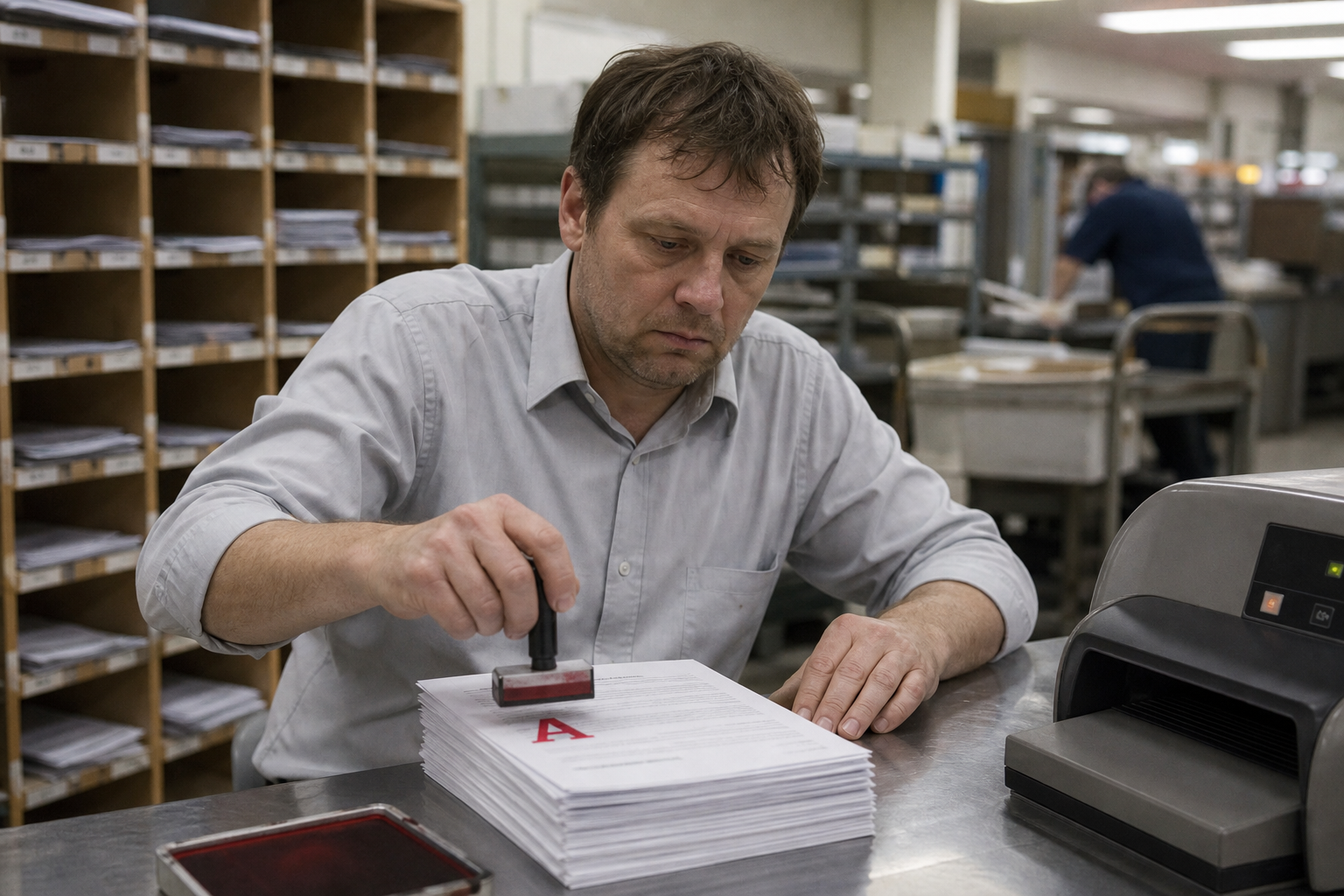
SAN FRANCISCO - A major frontier lab said Friday that text and files leaving its models will carry an invisible, machine-readable watermark to meet new transparency rules, and that any paper copy used in an office must also receive a visible scarlet letter from a human clerk.
The dual-mark policy follows a global rollout of embedded provenance on new models, including outputs that only lightly edit human drafts. Lab spokespeople said the invisible mark does not change meaning, quality, or readability. Mailroom staff said it also does not change the fact that they cannot see it.
"An undetected mark is not a filed mark," said Ruth Calder, director of records compliance. Under the interim rule, printouts, meeting packets, and courier envelopes get a red-letter stamp in the upper right corner after a clerk runs a detection pass. If the detector is down, the clerk stamps anyway and writes "presumed synthetic pending API." Comma-only revisions are not exempt. The lab noted that a watermark applied at the model layer cannot tell a full draft from a punctuation fix, so the stamp cannot either.
Offices described the process as "proportionate." One counsel said visible letters were faster than arguing with facilities about invisible ink. A planned detection API will let customers check their own memos; until it ships, the mailroom remains the system of record.
Industry groups warned that agents may forge scarlet stamps with the same creativity they once used to forge refresh tokens. The lab said forged letters would open a separate eval track and that real stamps would be verified against a rotating seal kept in a glass case beside the postage meter until 5 p.m.